The Full Story
For all of history the sea keeps what it takes. A man can hold his breath and reach a drowned cannon, then he has to turn back. Whatever sinks is gone.
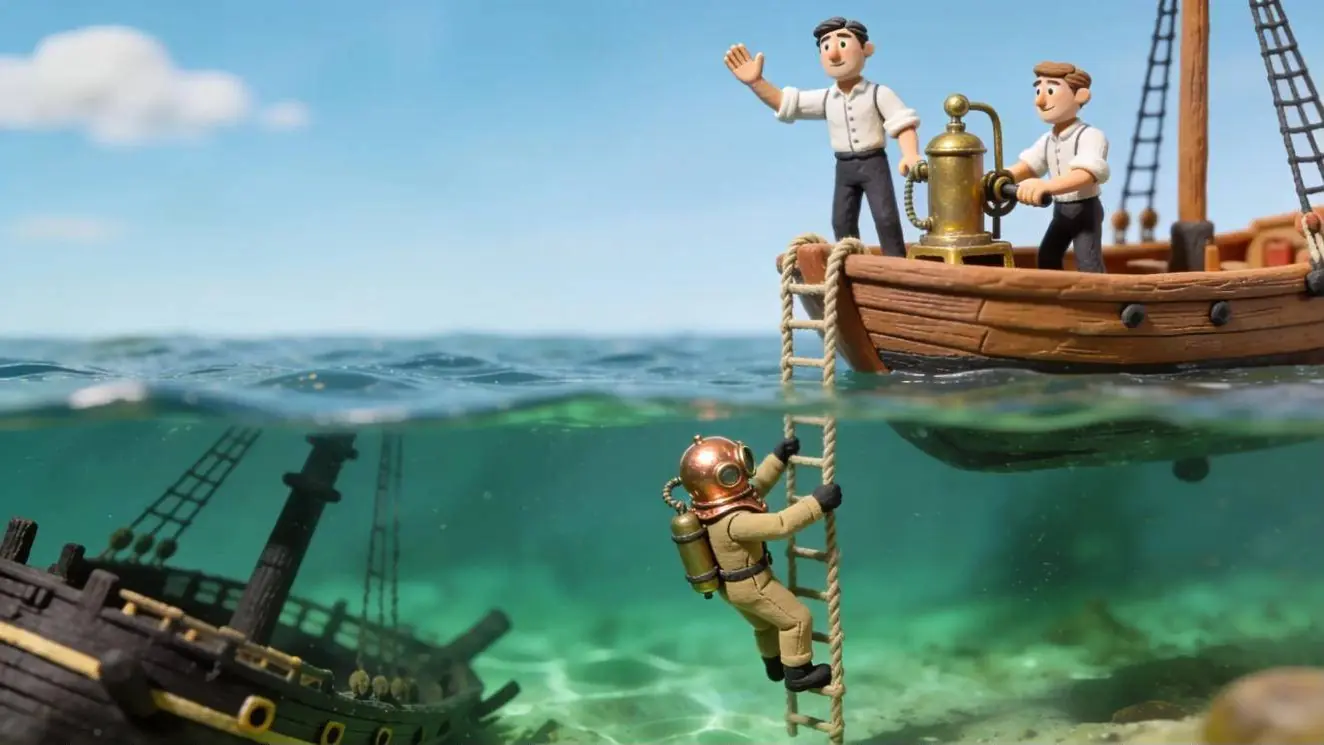
The way down starts as a fireman's helmet. In 1823 an Englishman, Charles Deane, patents a copper smoke helmet fed by a hose, built for walking into burning buildings. In 1828 he and his brother John take it underwater instead and prove it in the River Thames. For the first time, a man stands on a riverbed and works.
But the helmet only rests on his shoulders, held there by nothing but its own weight. If he bends too far, or falls, the sea pours in. Sometimes he comes up. Sometimes he does not.
The man who seals that flaw is not born British. Augustus Siebe is born in Saxony in 1788, trained young to work metal. He serves as a Prussian artillery officer, wounded at the Battle of Leipzig in 1813. When the wars end, he comes to Britain and by 1829 he is working from 5 Denmark Street, Soho, building precision instruments.
It is Siebe who manufactures the Deane brothers' helmets and refines them at their side, so no one knows the flaw better. In 1837 he ends it. He seals the helmet to a full suit of watertight rubberised canvas, the whole diver airtight, all but his hands. Now he can bend, stumble, even fall. The air stays in. The sea stays out.
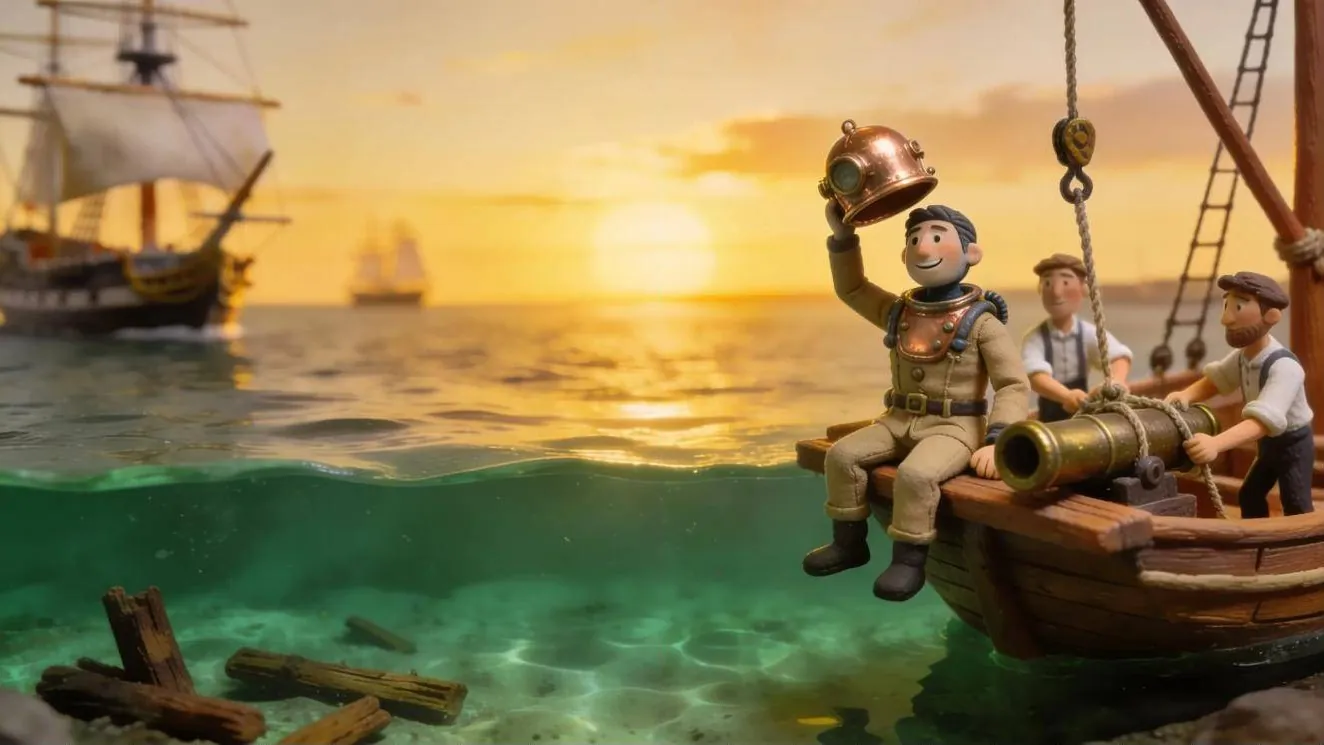
It needs proving. Britain has the perfect wreck waiting: the Royal George, sunk at Spithead in 1782, still being salvaged over 50 years later. The Deanes have already dived her in the open helmet, raising her guns. From 1839 Colonel Charles Pasley of the Royal Engineers works the wreck with gunpowder. In 1840 he moves his divers into Siebe's closed dress. No more ladders. No more flooding by a fall. The work runs until September 1843, when the anchorage is declared safe.
Siebe's design becomes the Standard Diving Dress, built in Soho, worn by navies and salvage crews across the world for over 100 years. He dies at his home on Denmark Street in 1872, aged 84. They sometimes call him the father of diving.
Two English brothers dared the water first. A Prussian hand in a Soho workshop made it give men back.
Why This Matters
Siebe's story is an honest one about shared credit. Honesty is worth more than a tidier legend. The Deane brothers invented the diving helmet and got it underwater first. Their invention nearly killed the men who wore it. Siebe, a Prussian soldier who settled in Soho after the Napoleonic wars, did not steal that credit. He fixed the one specific flaw that made the whole idea lethal. The world adopted his version because it actually worked. Britain gave a foreign craftsman a bench to build on. What came off it kept divers alive on the Royal Navy's wrecks and the world's seabeds for more than a century. Good engineering, not nationality, is what earns the credit here.
Key Facts
- ✓Charles Deane patented a copper smoke helmet for firefighters in 1823 (patent no. 4869). In 1828 he and his brother John adapted it for diving, proving it in the River Thames (Wikipedia)
- ✓The Deane helmet rested loose on the diver's shoulders by its own weight; if he bent over or fell, it could flood, sometimes fatally (Wikipedia)
- ✓Augustus Siebe, born in Saxony in 1788, was wounded as a Prussian artillery officer at the Battle of Leipzig in 1813 before settling in London and building precision instruments from 5 Denmark Street, Soho, from around 1829 (Wikipedia)
- ✓In 1837 Siebe sealed the diving helmet to a full watertight rubberised canvas suit, making the whole diver airtight except for his hands, the innovation that became the Standard Diving Dress (Wikipedia)
- ✓The design was proved on the wreck of the Royal George, sunk at Spithead in 1782, when Colonel Charles Pasley's Royal Engineers divers switched from the open helmet to Siebe's closed dress in 1840. The site was declared safe for shipping by September 1843 (Wikipedia)
- ✓Siebe's firm, later Siebe Gorman, supplied the Standard Diving Dress to navies and salvage operations worldwide for over a century; he died at Denmark Street, Soho, in 1872, aged 84 (Wikipedia)