The Full Story
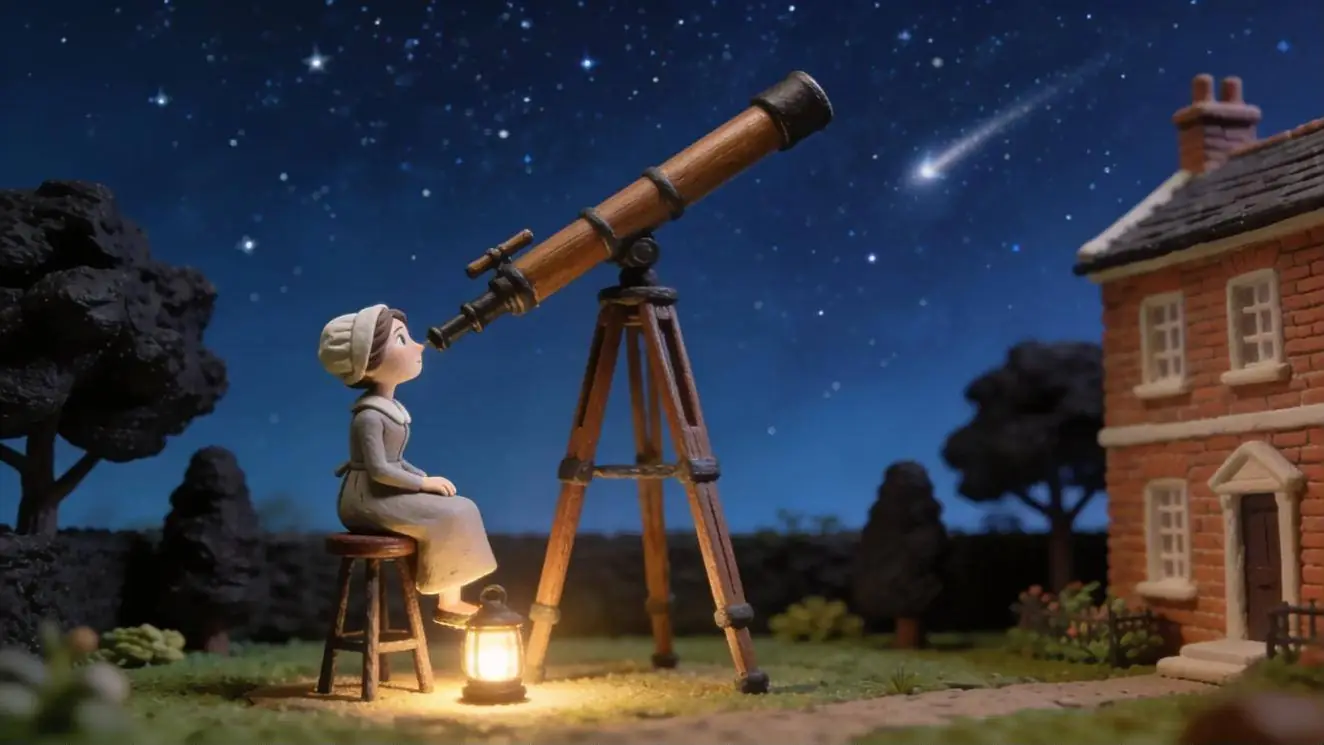
A vast midnight sky over a dark Georgian garden. A tiny woman on a stool at the eyepiece. 4 foot 3 in her boots, alone at the eyepiece. Something in the glass is moving. Something no woman has ever claimed.
She was never meant to be here at all. Caroline Herschel was born in Hanover, a bandsman's daughter. Smallpox scarred her face as a little girl. Typhus at 10 nearly killed her. She never grew another inch. Her mother decided no man would ever marry her, so she was trained for the scrubbing brush, a servant in her own family's house.
Then a letter came from her brother William, a musician in Bath. He offered her a way out: keep his house and learn to sing. In August 1772 she stepped ashore in England. It would be home for the next 50 years.
By day she ran his house and sang his concerts. By night, her brother answered to a different master, the sky. He ground telescope mirrors for hours on end. She fed him as he worked. In 1781, from their back garden, he found a planet, the first in recorded history. The King made him his astronomer. The household moved near Windsor. Caroline came as the housekeeper. Again.
Then William built his little sister a telescope of her own. She swept the sky with it. The night began to give things up. New nebulae of her own, 14 of them.
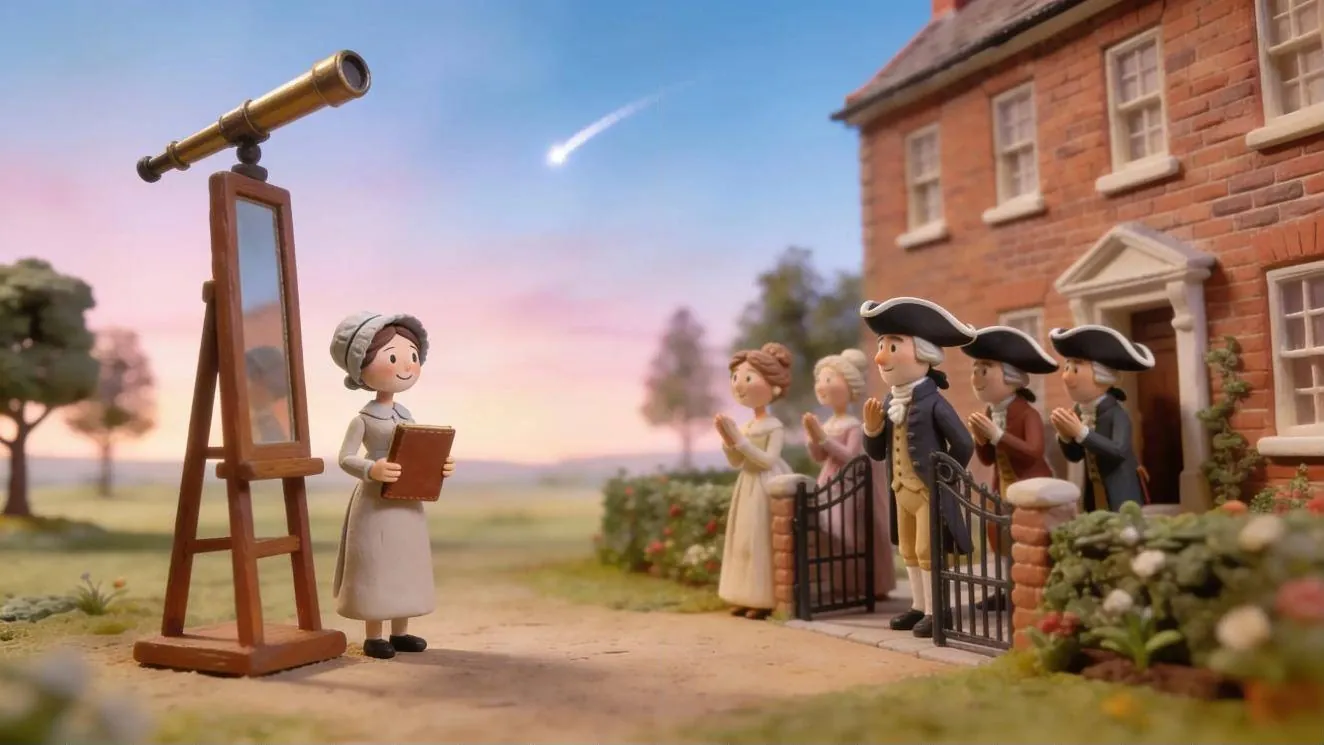
Then came a night in August 1786. William was away. The telescope was hers alone. Low in the glass sat a blur that had not been there the night before. It moved. A comet. The first ever found and claimed by a woman in her own name. London came to the door. The court called it the first lady's comet.
A year later, King George the 3rd put her on a royal salary. 50 pounds a year, in her own name. The first woman in Britain ever paid to do science. The girl trained to scrub floors was now paid to read the sky. 7 more comets followed. 8 in all.
England kept her for 50 years, until William died. Then she went home to Hanover and took the unfinished work with her. She set 2,500 nebulae in order, a catalogue for everyone who came after. In 1828 the Royal Astronomical Society sent its Gold Medal to Hanover. No woman won it again until 1996.
Her second comet is still out there, on the long road back. It returns around 2092. A girl in school today could live to watch it come home.
Why This Matters
Caroline Herschel was trained to be invisible, a servant in her own family's house, told plainly that no man would marry her. England gave her a different life by accident, keeping her brother's home. It was in the gaps of that ordinary work that she found a comet no woman had ever claimed in her own name. She was paid a salary by the crown for it, the first woman in Britain to earn a living from science. Her story matters because it did not happen in a university or an academy. It happened in a back garden, at night, to a woman the world had already decided was too small to matter.
Key Facts
- ✓Caroline Herschel was born in Hanover on 16 March 1750; smallpox scarred her face as a child and typhus at 10 stunted her growth, leaving her 4 feet 3 inches tall. Her mother trained her for domestic service (Wikipedia; Royal Museums Greenwich)
- ✓In August 1772 she moved to Bath, England, to keep house for her brother William and train as a singer. England remained her home for the next 50 years (Wikipedia; MacTutor)
- ✓On 13 March 1781 William discovered Uranus, the first planet found since antiquity, from their back garden in Bath and was appointed astronomer to King George III (Royal Museums Greenwich; Wikipedia)
- ✓William built Caroline her own small telescope, with which she independently discovered around 14 nebulae. On 1 August 1786 she found her first comet, received as the first comet found and claimed by a woman in her own name (Royal Museums Greenwich; Wikipedia)
- ✓In 1787 George III granted her £50 a year, making her the first woman in Britain paid for scientific work; she went on to discover 8 comets in total (Royal Museums Greenwich; Wikipedia)
- ✓After returning to Hanover in 1822 she catalogued 2,500 nebulae, earning the Royal Astronomical Society's Gold Medal in 1828; no woman won it again until Vera Rubin in 1996 (Royal Astronomical Society; Wikipedia)