The Full Story
For centuries, a darkened sun was read as an omen. On 2 August 1133 a total eclipse fell as King Henry I made his final crossing from England to Normandy. He never came back alive. He died in Normandy in 1135, more than two years later.
The chronicler William of Malmesbury still tied the two together, as if the heavens had mourned the king's last departure. England soon fell into years of chaos and civil war. A black sun and a dead king made a story people did not forget.
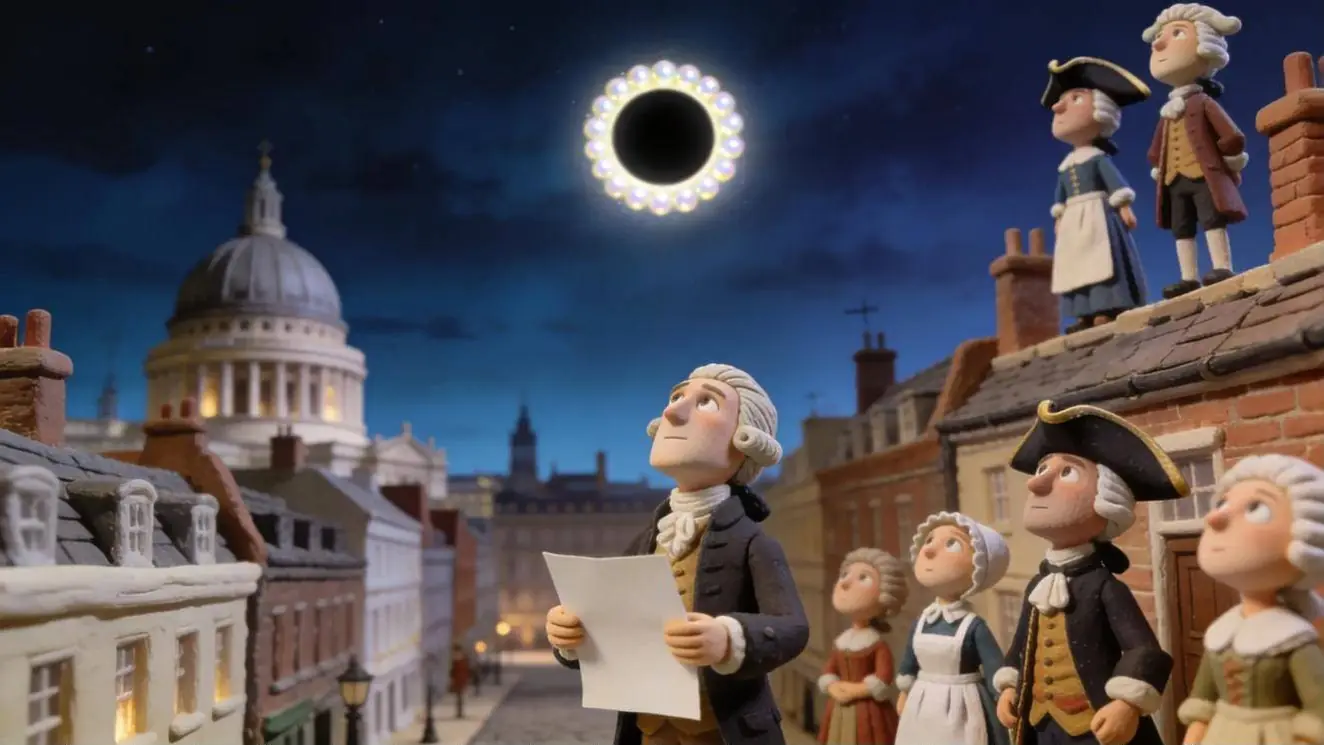
Nearly six centuries later, another total eclipse was on its way to England. Edmond Halley decided Britain would meet this one differently.
In early 1715 he published a map of England showing the path the Moon's shadow would take across the country. He was among the first ever to publish such a map before an eclipse. He wanted people to see the event for what it was, with, as he put it, "nothing in it more than Natural".
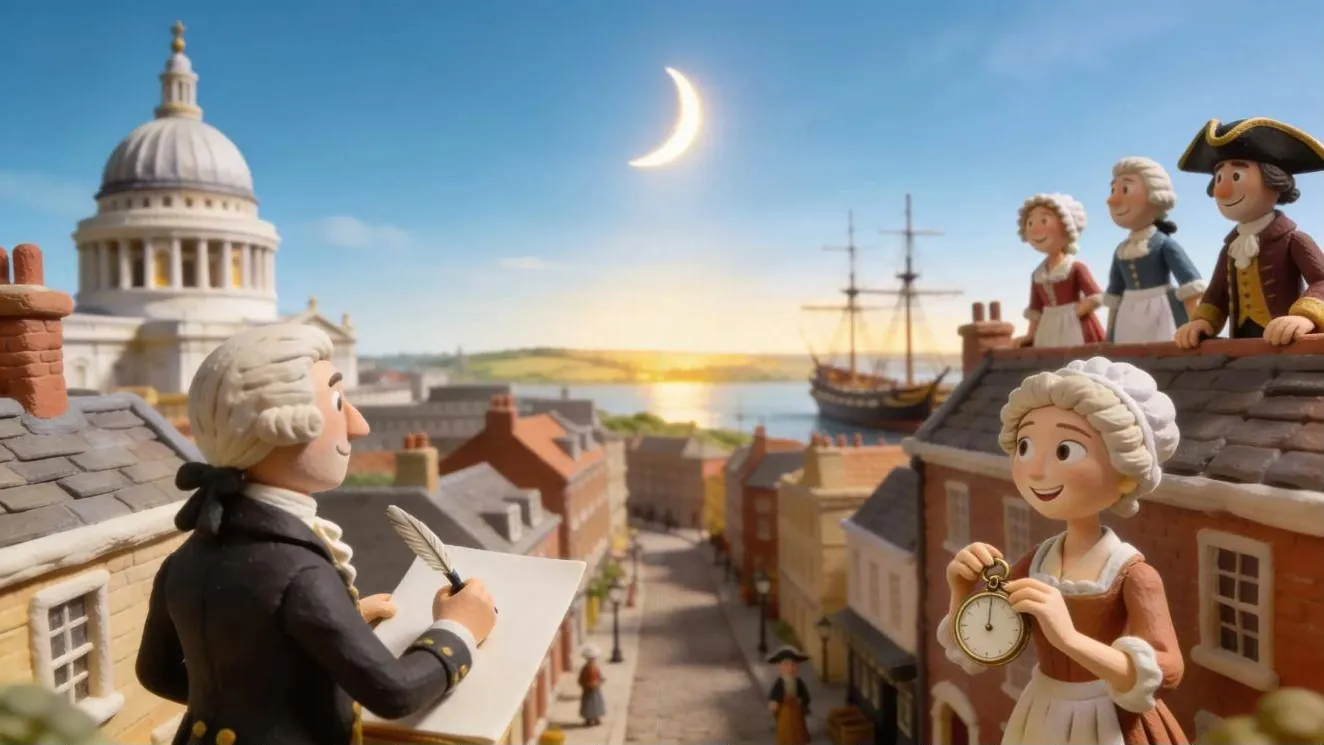
He also asked for help. His map invited "the Curious" to observe what they could, especially how long the total darkness lasted. Observers from across the country answered, sending in their reports.
The eclipse came on 22 April 1715 by the calendar Britain then used, which is 3 May in today's calendar. Totality swept from Cornwall to Lincolnshire and Norfolk. London had about three and a half minutes of darkness. Halley's timing for the start of the eclipse in London was within four minutes. His path was about 20 miles out. He used the reports he received to correct it. For the eclipse of 1724 he produced a more accurate map still.
That was the real breakthrough. A prediction was published in advance. Ordinary people checked it. The results improved the science. Fear gave way to curiosity.
Halley became Astronomer Royal in 1720. His name lives on in the comet whose return he predicted, which came back in 1758, years after his death. When a deep partial eclipse passed over Britain on 12 August 2026, people across the country stepped outside to look up. They were not afraid. That calm is part of what Halley handed down.
Why This Matters
Halley's eclipse map turned a moment of dread into a shared public experiment. He published his prediction openly, invited anyone curious to test it, then corrected his work using what they reported. That simple pattern still underpins how science earns trust: say what will happen, let people check, then learn from the results. It also shows ordinary Britons taking part in science long before it was a profession. Every time the country steps outside to watch the sky with curiosity instead of fear, it follows a path Halley drew in 1715.
Key Facts
- ✓William of Malmesbury tied the eclipse of 2 August 1133 to Henry I's death, though the king died more than two years later (Astronomy magazine)
- ✓The 1715 eclipse fell on 22 April Old Style, 3 May New Style, with about 3 minutes 33 seconds of totality in London (Wikipedia)
- ✓Halley calculated the start of the 1715 eclipse in London to within four minutes and was among the first to publish a path map in advance (The Royal Society)
- ✓His predicted path was about 20 miles off; he corrected it from observers' reports (Atlas Obscura; Royal Museums Greenwich)
- ✓Halley became Astronomer Royal in 1720 (Royal Museums Greenwich)
- ⚠The film's claim that Halley used Newton's mathematics for the 1715 prediction was not confirmed by the sources checked