
The Full Story
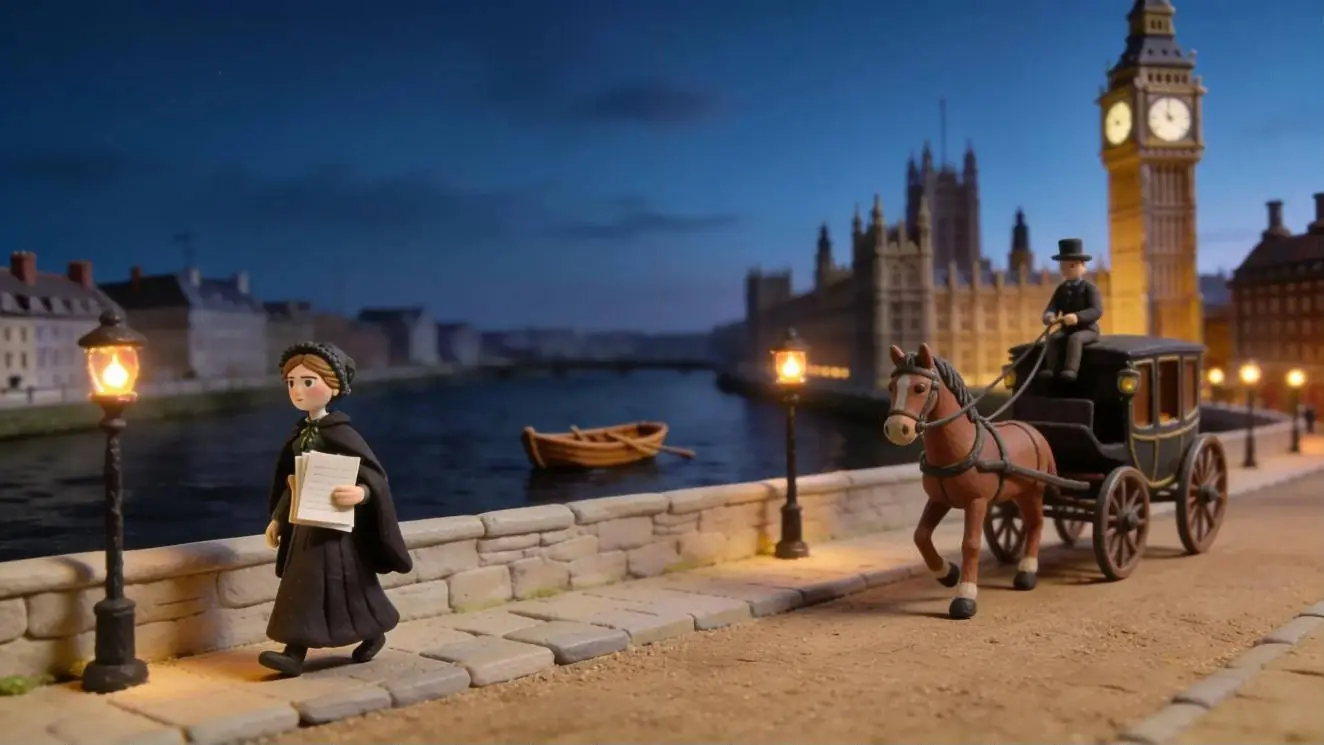
No law in Britain ever printed the word. But under every police-court report of the 1870s, one woman kept hearing it: that a man's wife was his property. Her name was Frances Power Cobbe, an Irishwoman born at Newbridge House, County Dublin, in 1822, who taught herself philosophy in her father's library and made her own living in London by her pen.
The trap she saw was cold and complete. A wife could take a violent husband to court. The court could fine him, even jail him. But when the sentence ended, she was still bound to him, legally obliged to live under his roof. Her children, in law, were his. Divorce sat in one London court, priced for the rich. For Britain's poorest wives, there was no way out.
So at 55, Cobbe built a case of her own. She went through 3 years of official returns and counted more than 6,000 of the worst cases. She called her essay Wife Torture in England. The Contemporary Review published it in April 1878. It did not plead. It documented. At the root of it all, she wrote, lay one notion: that a man's wife is his property, in the sense in which a horse is his property. Her exact words.
The final pages held her remedy: a separation order from the nearest magistrates' court. If a husband was convicted of aggravated assault on his wife, the court could order that she need never go back, with maintenance from him and her children under 10 beside her.
Weeks later, Parliament wrote it into law. The Matrimonial Causes Act received royal assent on 27 May 1878. Earlier reforms had reached the drawing rooms. This one reached the terraces, because any local magistrates' court could grant it. Wives began to walk out of courtrooms free, their children's hands in theirs.
She was not done. She had already founded the world's first anti-vivisection society. She argued for the vote she never lived to cast. She died at Hengwrt, near Dolgellau, Wales, in 1904.
One essay, by one woman. And the law of Britain moved in weeks.
Why This Matters
You are usually taught that the law moves slowly, from the top down, worn into shape over generations. In 1878 it moved in weeks, because one Irishwoman with no seat in Parliament and no vote of her own counted more than 6,000 of the worst cases the courts had recorded and made the case impossible to ignore. Frances Power Cobbe's essay did not invent the problem. It documented what the law already allowed and named the idea underneath it: that a wife was legally treated as property. The Matrimonial Causes Act 1878 that followed reached ordinary working wives, not just the wealthy, because any local magistrates' court could grant it. Cobbe is not a well-known name today. This channel exists partly to fix that kind of gap: to keep the names Britain owes, not just the ones it remembers.
Key Facts
- ✓Frances Power Cobbe, an Anglo-Irish writer and reformer, was born at Newbridge House, County Dublin, on 4 December 1822 and made her living in London as a journalist and essayist (Wikipedia)
- ✓Her essay Wife-Torture in England, published in the Contemporary Review in April 1878, drew on 3 years of official returns to document more than 6,000 of the worst cases of assault on wives (Wikipedia; Spartacus Educational)
- ✓Cobbe identified the root cause as the legal notion that a man's wife was his property, 'in the sense in which a horse is his property' (Wikipedia)
- ✓Her essay's proposed remedy, a magistrates' separation order for wives of husbands convicted of aggravated assault, with maintenance and custody of children under 10, was written into the Matrimonial Causes Act 1878, which received royal assent on 27 May 1878, weeks after publication (Wikipedia; legislation.gov.uk)
- ✓Cobbe founded the Victoria Street Society in 1875, the world's first anti-vivisection organisation and campaigned for women's suffrage as a member of the executive council of the London National Society for Women's Suffrage (Wikipedia)
- ✓She died at Hengwrt, near Dolgellau, Wales, on 5 April 1904 (Wikipedia)