The Full Story
While Egypt was building the pyramids, Britain was already running a mine.
In a pine forest in Norfolk, the ground is covered in hundreds of grassy hollows. The Anglo-Saxons gave the place its name. They called it after Grim, another name for their god Woden: Grim's Graves. Whoever they thought had made the hollows, it wasn't a god. People made them.
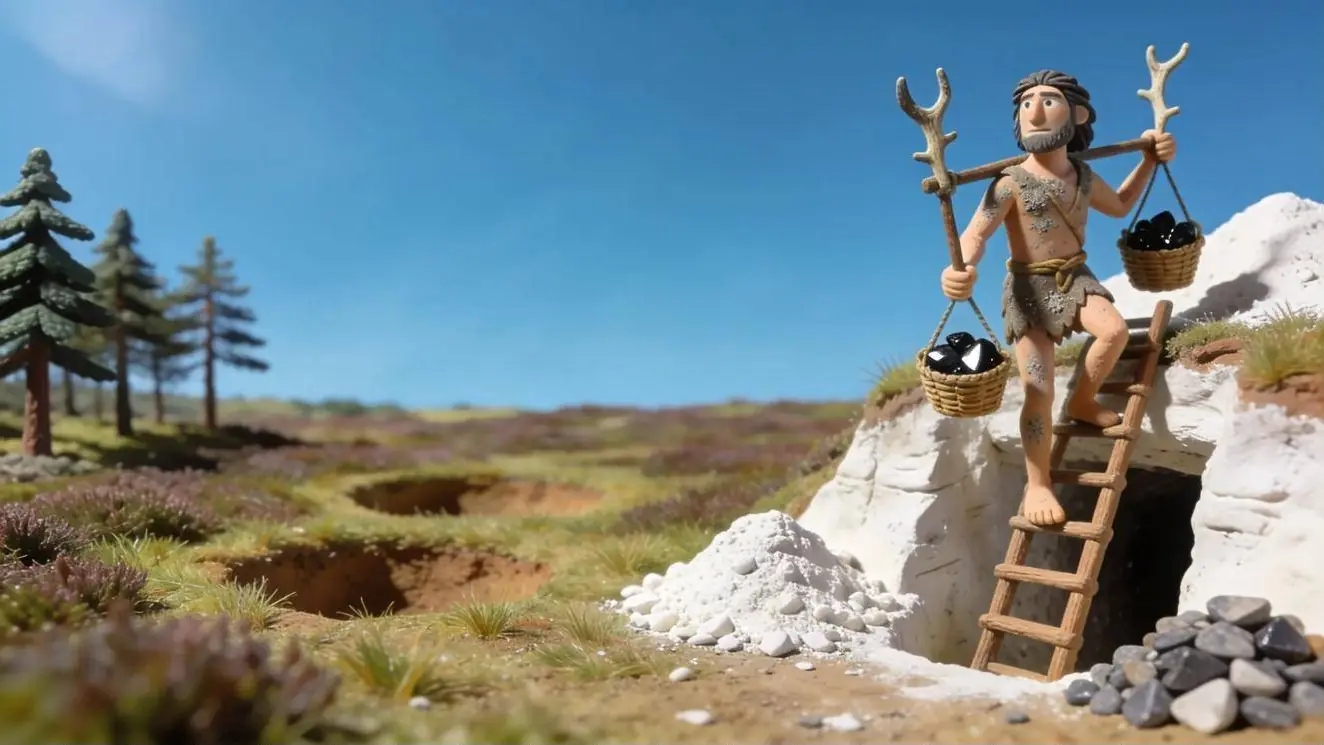
Around 2650 BC, Neolithic miners began digging straight down through the chalk, in places as deep as 13 metres, over 40 feet. They had no metal and no machines. Their picks were deer antlers. Their power was their own muscle. At the bottom they crawled sideways along narrow galleries in the dark, following a seam of fine flint. Then they hauled it to the surface.
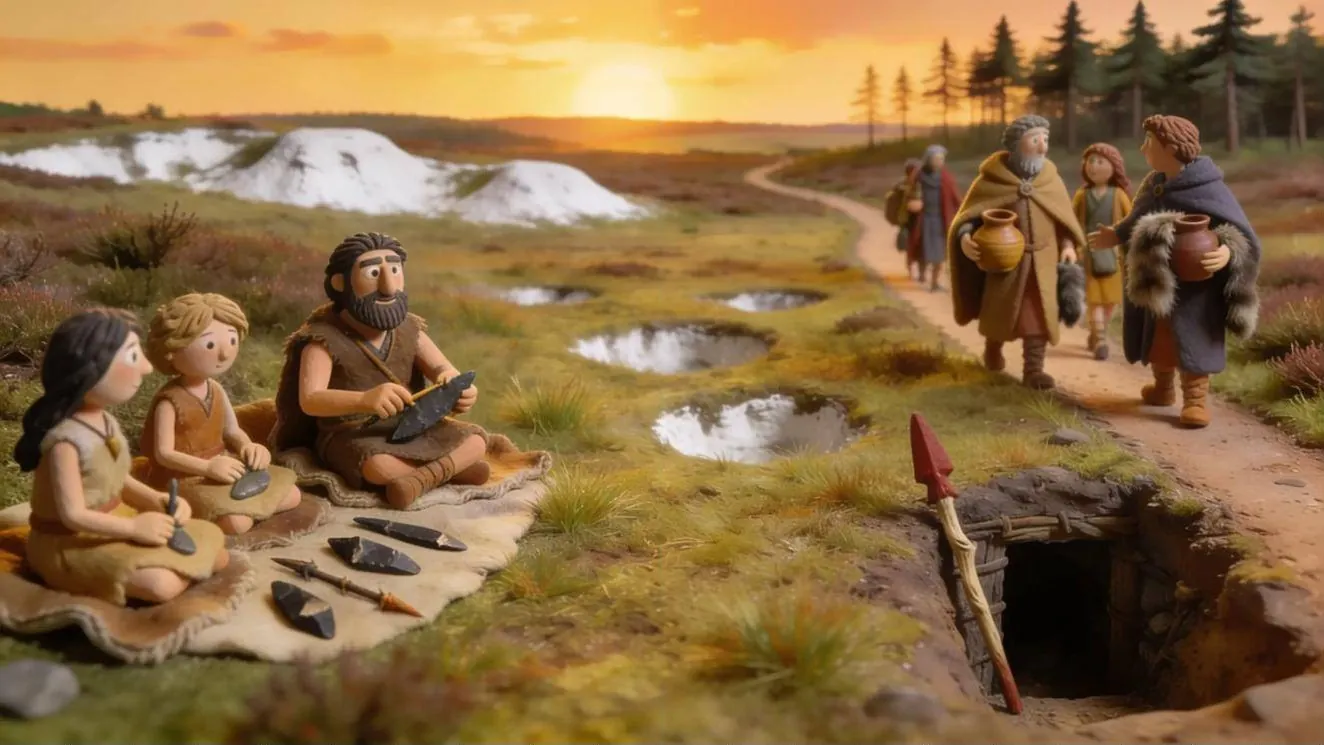
Up top, the flint became tools: axes, arrowheads, knives and scrapers. These were the tools that ran a whole way of life. They were traded far across the country. Some of the axes were never used at all. They seem to have been treasures, kept or buried rather than worked.
They didn't dig one mine. English Heritage records 433 mines and pits on the site. Clearing the chalk from one of the bigger shafts took a team of about twenty people around five months. Generation after generation came back to the same ground.
When archaeologists finally climbed down into the shafts, they found the miners' antler picks. Around 100 to 150 broken picks turn up in each excavated mine. The miners simply dropped them where they broke. Some still lie exactly where they were left 4,500 years ago, as if the shift had just ended.
For thousands of years nobody knew what the hollows were. Then between 1868 and 1870 Canon William Greenwell dug out one of the shafts. He proved for the first time that Neolithic people in Britain had mined deep underground. His shaft, Greenwell's Pit, has since been reopened for guided tours.
You can still go down. At Pit 1 you climb a 9 metre ladder into the chalk to stand where they stood. It is the only flint mine open to visitors in the UK.
Grime's Graves was the first site in the UK to be recognised as a Neolithic flint mine. Long before the Romans, the people of this island were already makers.
Why This Matters
Grime's Graves is one of the oldest industrial landscapes in Britain. It shows that Neolithic people here could plan, organise and carry out heavy work deep underground over many generations, with nothing but antler, stone and muscle. The flint they raised was traded across the country. It is a reminder that Britain's story did not begin with Rome. People on this island were sharing skills, organising labour and making things of real quality thousands of years before anyone wrote them down.
Key Facts
- ✓The earthworks at Grime's Graves are the remains of 433 mines and pits (English Heritage)
- ✓In the south of the site, shafts reach up to 13 metres deep (English Heritage)
- ✓Archaeological evidence suggests the mines were first dug around 2650 BC (English Heritage)
- ✓Around 100 to 150 broken antler picks have been found in each excavated mine, discarded where the miners worked (English Heritage)
- ✓Pit 1, reached by a 9 metre ladder, is the only flint mine open to visitors in the UK (English Heritage)
- ⚠How long mining lasted is uncertain. Wikipedia gives c. 2600 to 2300 BC, while English Heritage research points to some mining in the early Bronze Age. The film's figure of around 500 years could not be confirmed.