
The Full Story
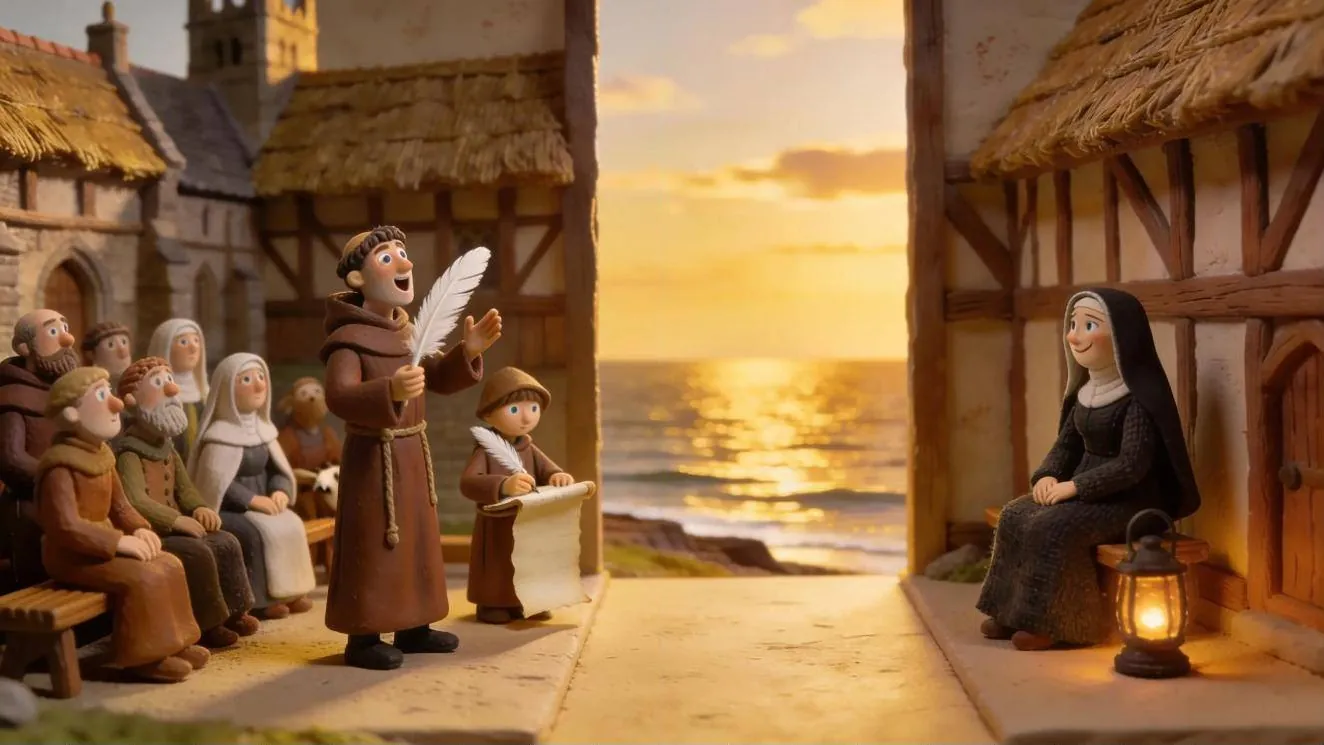
His name is Cædmon, a farmhand on a high headland over the North Sea. Every feast, the harp comes round the table. Every feast, he slips away before it reaches him.
Then one night, Bede tells us, a voice speaks into his sleep: sing me the beginning of things. He wakes with verses no one has ever taught him. By morning the farm reeve is marching him up the cliff, to the abbess herself.
She could laugh a dreaming cowherd back to his cattle. But the woman by the fire is Hilda of Whitby. Born royal, kin to Edwin, king of Northumbria, she was baptised at 13 beside him with the whole royal court. She was bound for Gaul when Aidan of Lindisfarne called her back. In 657 she founded her own abbey at Whitby, high above the sea, monks on one side, nuns on the other, one woman over both. She built it into a school that sent out 5 future bishops. Bede says ordinary folk carried their troubles up that cliff. So did kings.
In 664, kings and bishops climb it too. The church has split over one question: the date of Easter. Under Hilda's roof, the king chooses one calendar, so the kingdom can keep one feast. Hilda had stood with the other side. She loses, accepts it and keeps her people together.
That is the judge the cowherd stands before. She does not laugh. She sits him before her scholars and asks for the song. He sings. They hear something no schooling can explain. So Hilda sets a test: a passage of scripture, turned to verse by morning. He comes back with it made.
Hilda takes him in. The cowherd becomes a brother of the abbey. He spends the rest of his life turning scripture into English song. The 9 lines from the byre are the first English poem with a name on it. English poetry begins with a farmhand, because an abbess took him seriously.
Hilda burns with fever for her last 6 years and never stops teaching. She dies in 680. All who knew her, Bede wrote, called her mother.
The shore below her abbey is coiled with stones like sleeping snakes. Legend says Hilda turned the serpents of Whitby to stone. The town's coat of arms carries 3 of them to this day.
Why This Matters
This is a story about who gets taken seriously. A farmhand with no schooling wakes with verses in his head. The woman he is marched before, the most listened-to figure in the kingdom, kings included, chooses to test him rather than dismiss him. Because Hilda of Whitby did not laugh, Cædmon's Hymn survives as the first English poem with a name attached to it. English-language poetry has a founding moment that begins with an ordinary working man rather than a court poet. Hilda herself is worth remembering on her own account too: a royal woman who built one of the most influential schools in Anglo-Saxon England, hosted the synod that gave Northumbria one shared calendar, lost the argument and kept her community together anyway. Britain's literary history starts, provably, with someone deciding an ordinary man's word was worth hearing out.
Key Facts
- ✓Hilda of Whitby, born around 614, great-niece of King Edwin of Northumbria, founded the double monastery at Whitby (Streoneshalh) in 657 and ruled it as abbess until her death (Bede, Ecclesiastical History IV.23; Wikipedia)
- ✓Bede records that both ordinary people and kings sought Hilda's counsel and that five men trained at her monastery became bishops (Bede, Ecclesiastical History IV.23)
- ✓Hilda hosted the Synod of Whitby in 664, where King Oswiu ruled in favour of the Roman method of calculating Easter; Hilda had supported the other position but accepted the ruling (Wikipedia)
- ✓Bede's account (Ecclesiastical History IV.24) describes Cædmon, an elderly lay herdsman on Hilda's monastic estate, receiving verses in a dream, being brought before Hilda and her scholars, passing a test of turning scripture to verse and being received into the community
- ✓Cædmon's Hymn, 9 lines of Old English preserved in manuscripts of Bede, is the earliest English poem attributable to a named poet (Wikipedia)
- ✓Hilda suffered fever for the last 6 years of her life, taught until the end and died on 17 November 680; Bede wrote that all who knew her called her mother (Bede, Ecclesiastical History IV.23)