The Full Story
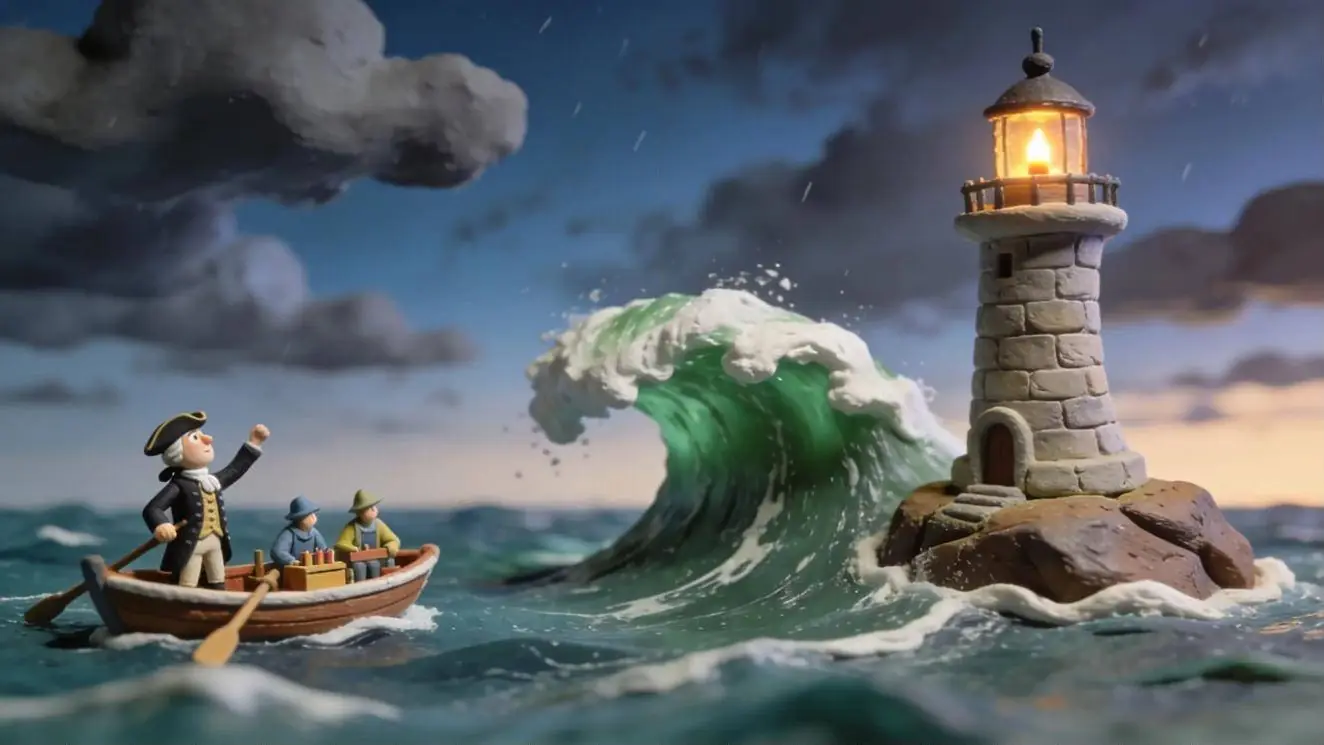
Two lighthouses have already died on this rock, 14 miles south of Plymouth, called the Eddystone. Henry Winstanley's timber tower vanishes into the Great Storm of 1703, taking him and 5 other men. John Rudyerd's tower burns to the waterline in 1755, after standing 47 years.
Britain faces a question. How do you build on a rock the sea owns?
The Royal Society's answer is not a lighthouse man. It is John Smeaton, an Englishman from Austhorpe near Leeds, a maker of scientific instruments who has turned his mind to engineering.
He starts with a question nobody has thought to ask. Why does an oak tree survive a storm? Wide at the root, narrow at the top. He shapes his tower like the trunk of an oak.
Wood has washed away and wood has burned, so Smeaton builds in granite. He cuts every block to dovetail into its neighbour, a carpenter's joint in stone and pins course to course with dowels of marble. For the mortar he runs experiment after experiment until he proves which limestone sets hard even underwater, a lime the Romans used and whose science had been lost. He works out why it set and brings it back.
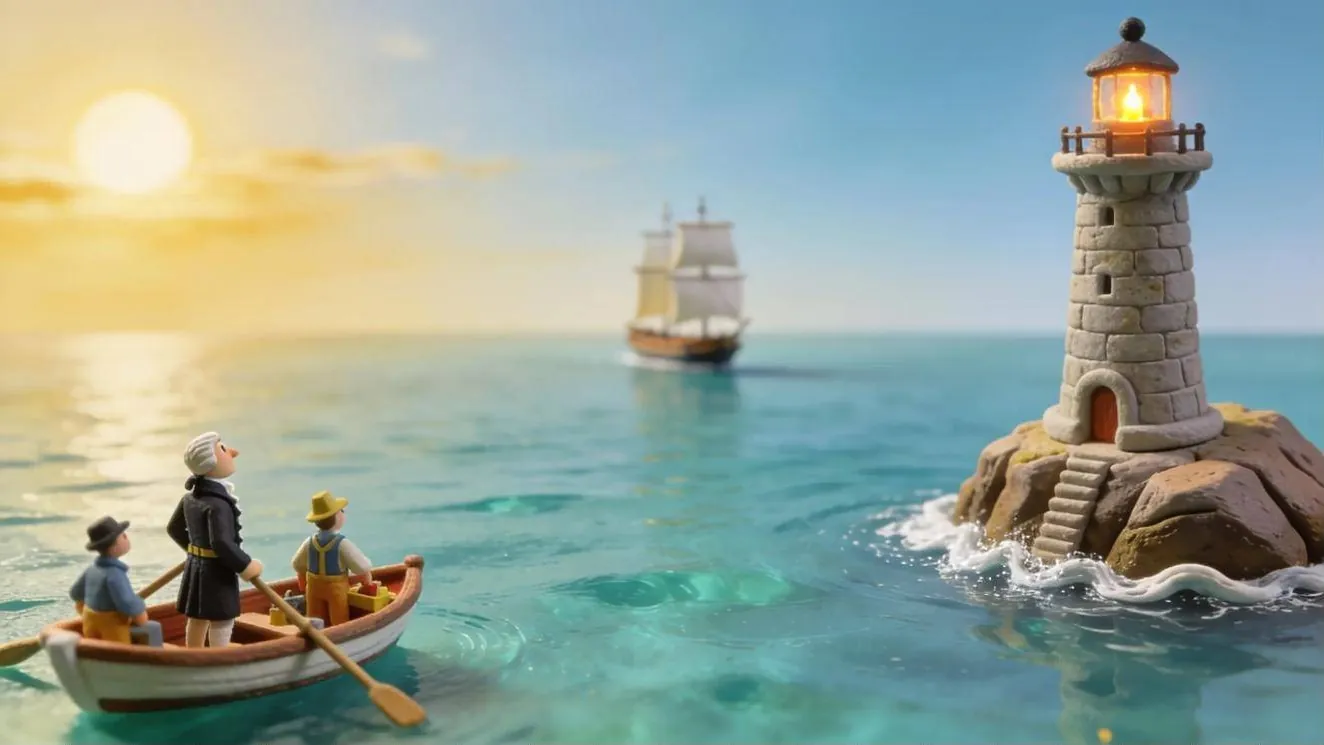
The tower takes 3 years, 1756 to 1759, built 14 miles out in the open sea. Then the lamp is lit. The sea comes to test it, winter after winter. It does not move.
Smeaton goes on to build bridges, harbours, canals and mills across Britain. Because the only engineers the country names are soldiers, he calls himself a civil engineer, the first man in Britain to do so. In 1771 he and 6 others found the world's first engineering society, in a London tavern. It still exists.
His light burns for 123 years. When engineers finally find a fault in 1877, it is not in the tower. It is the rock. The sea has been wearing away the reef beneath it. His tower has outlasted the rock it stands on.
In 1882 the lamp goes out for the last time. But nobody scraps the tower. The top comes down stone by stone and goes back up on Plymouth Hoe, opening in 1884. It stands there today, in its red and white bands. You can climb it. Out at sea, the stump of the original base still grips the rock, beside the light that replaced it.
Why This Matters
Two showpiece towers already lay wrecked on this rock, one drowning 6 men, before anyone thought to ask why an oak tree survives a storm. Smeaton was not a naval architect or a courtier's engineer. He was an instrument maker from Yorkshire who tested his own certainty against the sea with cold experiments, not confidence, until the granite dovetailed like carpentry and the mortar set hard underwater. His tower outlived the rock beneath it. He coined the term civil engineer to describe work no institution had a name for yet. It is a story about testing an idea until it is actually true, not until it merely sounds true and about the plain graft that keeps a coastline safe long after the people who did it are gone.
Key Facts
- ✓Two earlier Eddystone lighthouses were destroyed before Smeaton's: Henry Winstanley's wooden tower vanished without trace in the Great Storm of 1703, killing Winstanley and 5 others. John Rudyerd's timber tower burned down in 1755 after standing 47 years (Wikipedia; ASCE)
- ✓Smeaton, born in Austhorpe near Leeds in 1724 and trained as a scientific instrument maker, was recommended by the Royal Society to design the third Eddystone Lighthouse, built 1756 to 1759 (Wikipedia)
- ✓He shaped the tower like the trunk of an oak tree, wide at the base and tapering upward and locked its granite blocks together with dovetail joints and marble dowels (Wikipedia; ASCE)
- ✓He proved by his own experiments which limestone produces a mortar that sets hard underwater, reviving a hydraulic lime technique the Romans had used (Wikipedia)
- ✓Smeaton's lighthouse served from 1759 to 1882, 123 years and was retired only because the rock beneath it, not the tower itself, had eroded (Wikipedia)
- ✓He coined the term civil engineer and in 1771 founded the Society of Civil Engineers, the first engineering society anywhere in the world, which survives today as the Smeatonian Society of Civil Engineers (Wikipedia)