
The Full Story
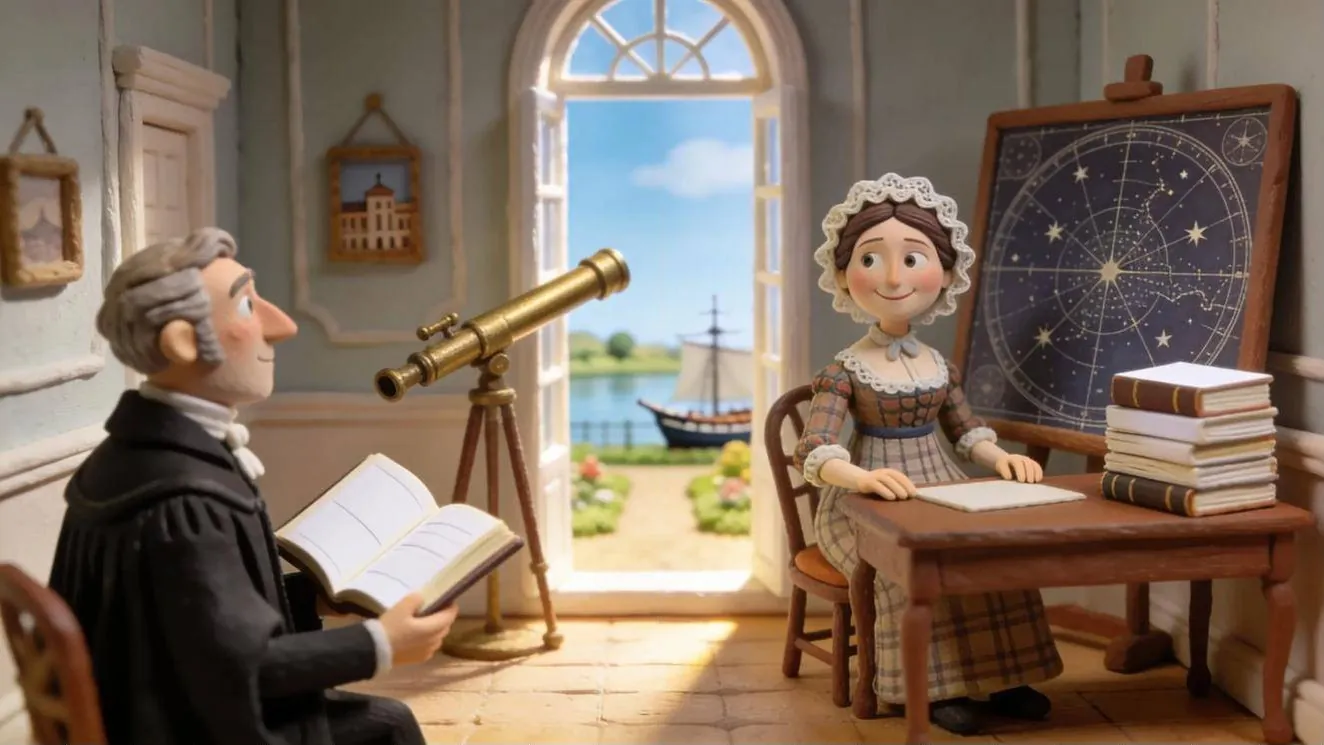
A candlelit desk, a huge star chart spread across it. Physics, chemistry, astronomy: one mind holding all of it.
No word existed for what she was. So Britain had to make one.
Her name was Mary Somerville, a Scotswoman raised on the Fife shore. Her whole schooling was one year, at a girls' boarding school in Musselburgh. She left it feeling, she said, like a wild animal escaped out of a cage.
After that she taught herself, from the shelves of the family home, by candles they tried to take away. The spark was a puzzle on the back page of a friend's fashion magazine, numbers mixed in with letters. Nobody she asked could explain it. It was algebra. She wanted more. Custom stopped a woman buying such books, so her brother's tutor bought her Euclid. She worked through it alone, line by line. By 1811 she had taught herself enough to win a silver medal for mathematics.
Then she took on Laplace's Mecanique Celeste, the mathematics of the heavens, in French. Asked to translate it for British readers, she did far more: she rebuilt the mathematics inside it, filling in the steps English readers lacked. In 1831 it went to print as The Mechanism of the Heavens. Cambridge set it in front of its own students.
Three years later she went further and joined the sciences together: physics, chemistry, astronomy, light, tides and magnetism, in one book anyone could read. It sold and sold. It broke open the English language. The Cambridge professor William Whewell sat down to review it. No single word covered what she did. Man of science would not do. His review put one into print for the first time. Scientist. The first person it ever described in print was a Scotswoman.
A year on, she and Caroline Herschel became the Royal Astronomical Society's first women Honorary Members. She was not done. Her own writing about a wobble in Uranus's orbit helped point the young mathematician John Couch Adams at the hunt that found Neptune in 1846.
In 1866 her name went first on John Stuart Mill's petition to Parliament for women's votes. Oxford named a college for her seven years after her death. And since 2017 her face has sat on the Royal Bank of Scotland's ten pound note, printed beside a line from the book that needed a new word.
Why This Matters
Mary Somerville had one year of formal schooling and taught herself the rest, at night, against her family's wishes. Her achievement was not just personal: when a Cambridge professor reviewed her book in 1834, the existing vocabulary of "natural philosopher" and "man of science" simply did not fit what she had done, spanning physics, chemistry and astronomy in one accessible book. His review is the document usually credited with putting the word "scientist" into print for the first time. Her own writing also helped point mathematicians toward the discovery of Neptune, though the calculation itself was not hers. She is a reminder that Britain's scientific language and its scientific institutions were shaped by people the institutions themselves were built to exclude. That self-teaching, against real obstacles, produced work that changed how the whole country talks about science.
Key Facts
- ✓Mary Somerville had exactly one year of formal schooling, at a girls' boarding school in Musselburgh, before teaching herself from her family's library (MacTutor)
- ✓She won a silver medal for mathematics in 1811, entirely self-taught and went on to translate and expand Laplace's Mecanique Celeste as The Mechanism of the Heavens (1831), which became a Cambridge set text (MacTutor)
- ✓William Whewell's March 1834 review of her book On the Connexion of the Physical Sciences is the document usually credited with putting the word "scientist" into print for the first time (Wikipedia: Mary Somerville)
- ✓In 1835 she and Caroline Herschel became the first women elected Honorary Members of the Royal Astronomical Society (MacTutor)
- ✓Her writing on the unexplained motion of Uranus is credited with helping point John Couch Adams toward the calculations that led to Neptune's discovery in 1846 (MacTutor)
- ✓Since October 2017 her portrait has appeared on the Royal Bank of Scotland's £10 note (NatWest Group Heritage Hub)