The Full Story
Put your hand on your chest. Feel that?
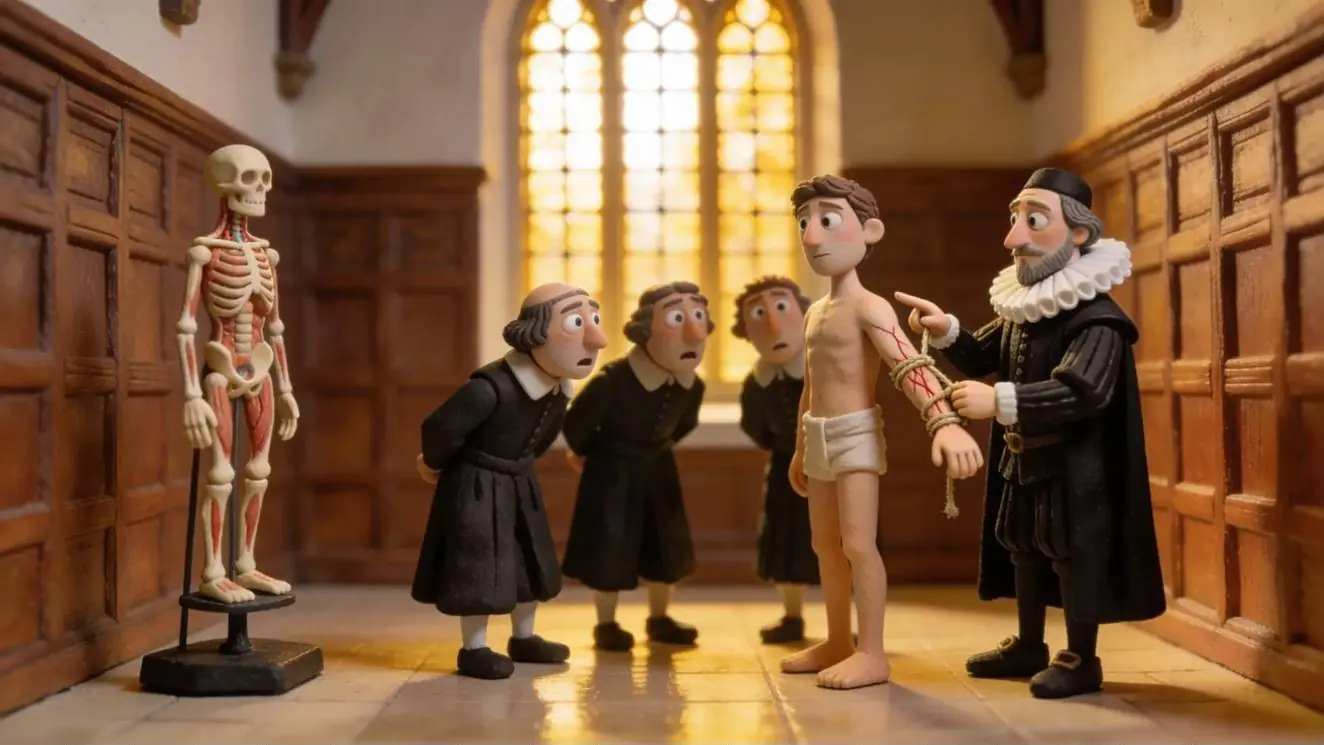
For around 1,400 years, doctors got it wrong. They followed Galen, a Greek physician of the 2nd century. He taught that blood was made in the liver, then carried out through the veins and used up by the body, like fuel. The liver simply made more. Hardly anyone checked.
Then came a boy from Folkestone. William Harvey was born there in April 1578. In 1609 he became physician to St Bartholomew's Hospital in London. He did something almost nobody had bothered to do. He counted. He first set out his idea in lectures in 1616. It would be twelve more years before he dared to print it.
How much blood does the heart push out with each beat? He made a deliberately low guess, just a few millilitres. How many beats in half an hour? Around a thousand. So he did the sum. Even on his low guess, the heart pushed out more blood in a single day than the whole body weighs. No liver could make that much. So the blood couldn't be getting used up. It had to be going round.
In 1628 he published his book, On the Motion of the Heart and Blood. It came out in Frankfurt, where the great book fair carried it across Europe. Many doctors were hostile. Some called him a quack. Some said they would rather be wrong with Galen than right with Harvey. His private practice fell away. He didn't back down.
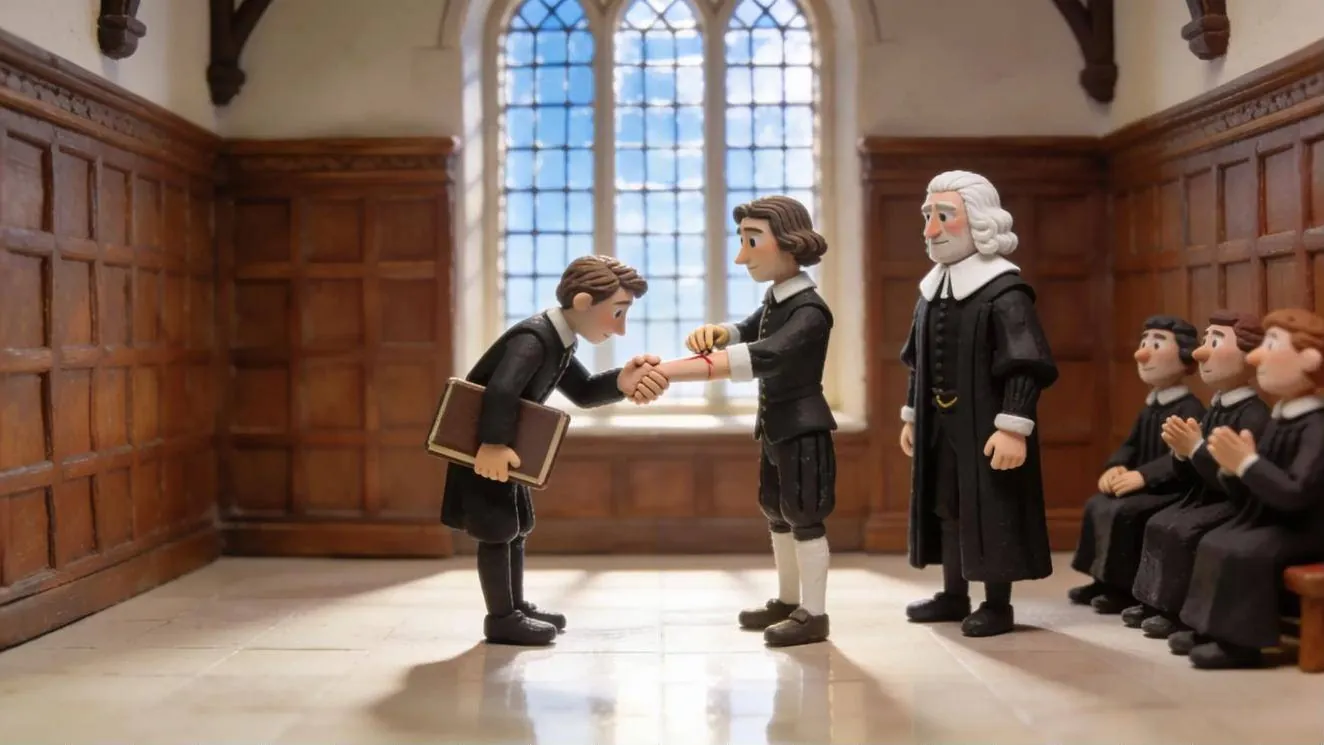
He tied bands round people's arms. He pressed on their veins. He showed how the little valves inside the veins only let blood flow one way, back towards the heart. The valves had already been described by the Italian anatomist Hieronymus Fabricius. Harvey showed what they were for. Slowly the argument was won. It took about twenty years. By the time he died in 1657, his idea was widely accepted.
Every blood test you've ever had. Every heart operation. Every transfusion. They all build on a man from Kent who counted. His bronze statue has stood on the Leas, the clifftop in Folkestone, since 1881.
Feel it again. Four hundred years ago, a man from Kent worked out what it's doing.
Why This Matters
Harvey did more than discover how blood moves. He showed how to overturn an old authority with measurement plus simple arithmetic. By counting, he proved that an idea which had stood for fourteen centuries could not be true. The circulation of the blood is a foundation of modern medicine. Transfusions, blood pressure checks, heart surgery and the drugs that keep hearts beating all rest on it. A physician at a London hospital, born in a Kent harbour town, changed medicine by refusing to take Galen's word for it.
Key Facts
- ✓Harvey was born in Folkestone, Kent, on the 1st or 2nd of April 1578 (Royal College of Physicians)
- ✓He was elected physician to St Bartholomew's Hospital in 1609 (Royal College of Physicians)
- ✓Assuming about 1,000 beats per half hour, Harvey showed the liver would have to make more blood each day than the whole body weighs (Wikipedia)
- ✓Galen taught that venous blood formed in the liver and was consumed by the body (National Geographic)
- ✓After publication his private practice suffered and some doctors accused him of quackery (National Geographic)
- ✓The bronze statue of Harvey on the Leas, Folkestone, by A. B. Joy, dates from 1881 and is Grade II listed (Kent Historic Environment Record)