The Full Story
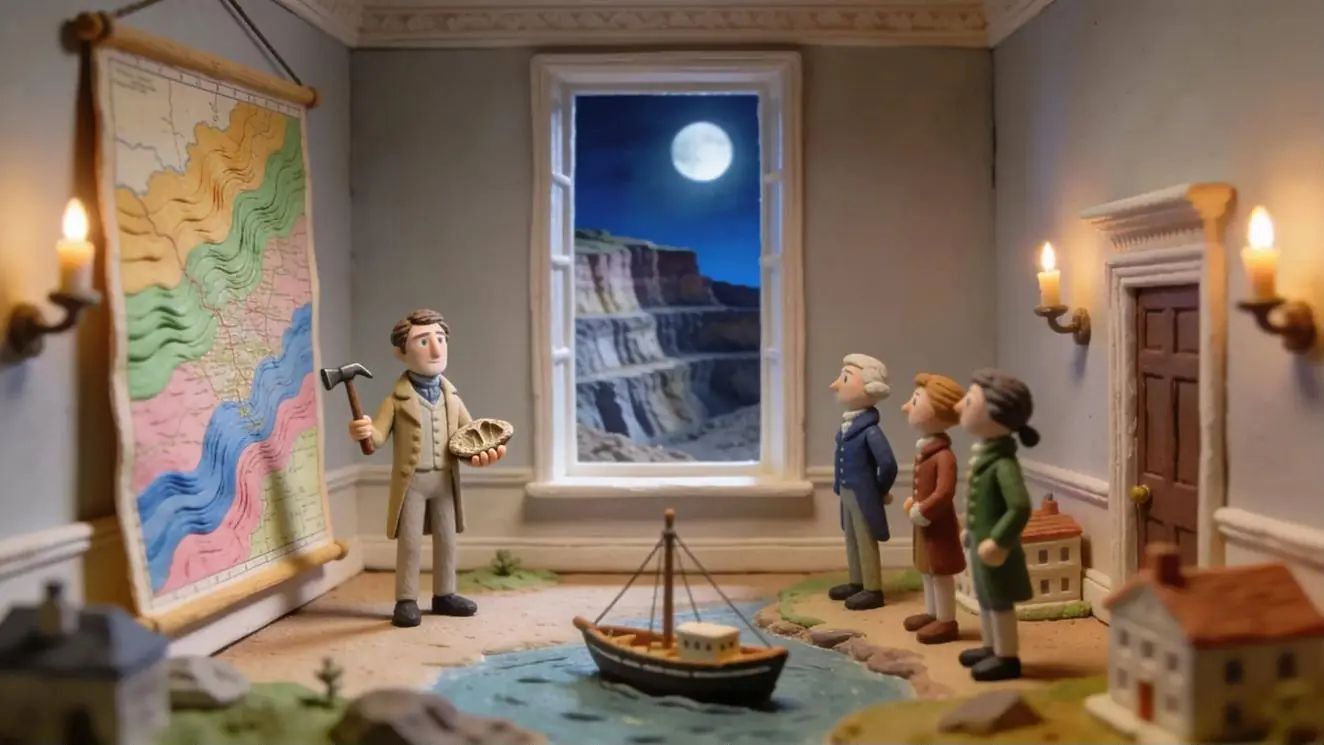
A map hangs in a candlelit Georgian room, taller than a man, covered in flowing hand-tinted bands of colour. Not roads. Not towns. The buried country underneath, drawn across a whole country by one man. A blacksmith's son.
His name was William Smith, an Englishman from a small Oxfordshire village. His father, the village blacksmith, died when he was 8. The village school taught him little, so he bought his own books and taught himself the surveyor's trade. By 18, survey work was sending him down the coal pits of Somerset.
Down in the dark, the ground showed him its secret. The rock lay in layers, stacked like the pages of a book, always in the same order. And each layer held its own fossils, like a signature in the stone. Read the signature. He could tell which page of England he stood on. Then a canal was cut through the hills. The same pages ran on for miles. He would map the whole buried country. All of it.
No patron paid him. No academy sent him. By coach, on horseback and on foot, he crossed England and Wales for years, notebook after notebook, quarry by quarry, pit by pit. The task swallowed the best part of 15 years.
In 1815, he unrolled the answer. A map taller than a man, 8 and a half feet by 6, every buried layer of England and Wales tinted by his own hand. The first detailed geological map of any country on Earth. He priced it at 5 guineas a copy. It barely sold.
Travel had eaten his savings. A failed quarry venture ate the rest. He sold his fossils, a life's collection, to the British Museum for £700. It was not enough. In 1819, the King's Bench debtors' prison closed its gates on him. He walked out that summer to bailiffs at his own door and left London with his tools on his back.
London's Geological Society, a club of gentlemen, had never asked him to join. In 1820, its president published a grand map of his own. Smith's hard-won lines ran through it. His name appeared nowhere on it. But younger geologists knew exactly whose lines they were walking.
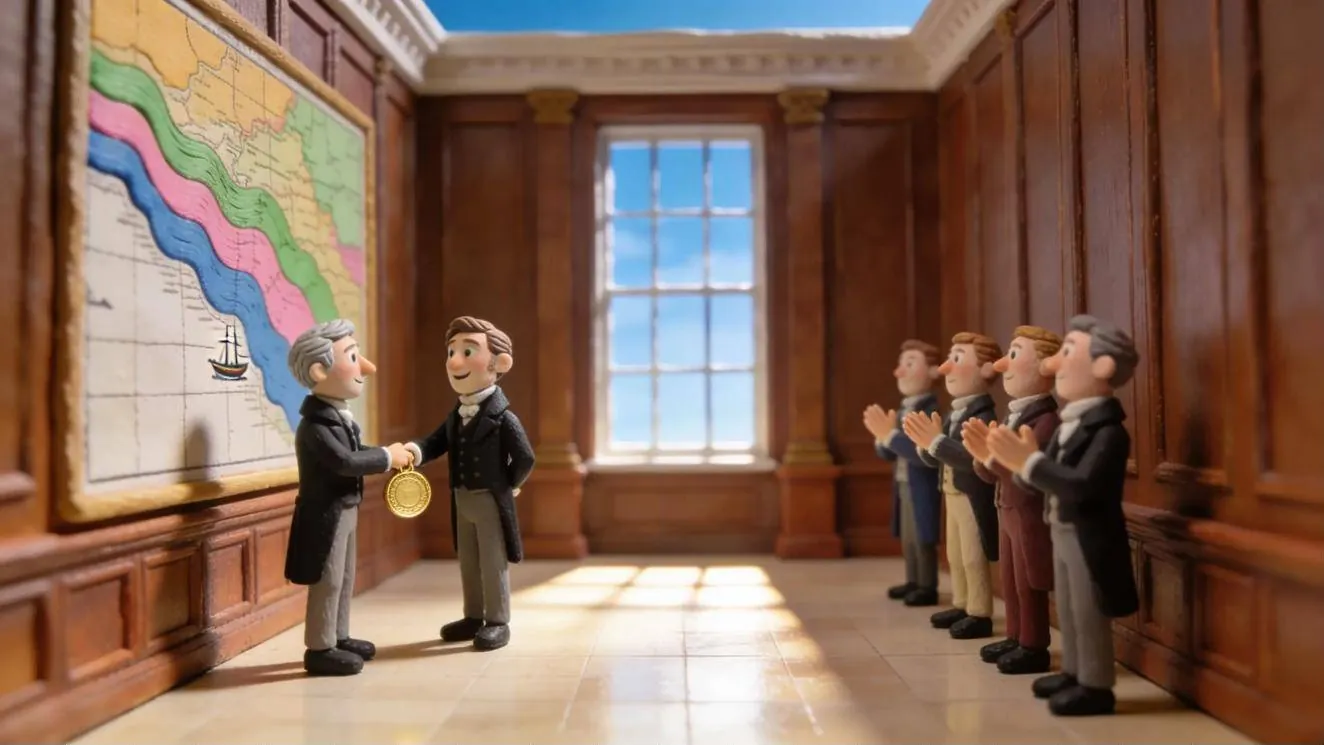
In 1831, the same Society struck its first Wollaston Medal, its highest honour. The first name called was William Smith. Its president named him the Father of English Geology. Today his map hangs in the Society's own hall in London. Every geological map on Earth is built on what he drew.
Why This Matters
This is a story about who gets to own knowledge. William Smith had no university training and no patron, only a blacksmith's forge and a coal pit that taught him the ground's own logic. He gave that logic to the whole country in a map bought by almost nobody, then lost his home and his freedom to debt while a gentlemen's society published his work under someone else's name. The channel exists to correct that kind of erasure. Smith was eventually honoured, but honesty means showing the theft and the ruin alongside the medal, because the map that underpins modern geology was drawn by a man the institutions of his day would not let through the door.
Key Facts
- ✓William Smith was born in 1769 in Churchill, Oxfordshire; his father, the village blacksmith, died in 1777 when William was 8 (Wikipedia; Oxford University Museum of Natural History)
- ✓Largely self-taught, he became a surveyor and, from 1791, worked in the Somerset coalfield, where he observed that rock strata always occurred in the same order and could be identified by their fossils (Natural History Museum; Wikipedia)
- ✓In 1815 he published 'A Delineation of the Strata of England and Wales', roughly 8.5 by 6 feet, the first detailed geological map of any country on Earth, priced at 5 guineas a copy (Natural History Museum; Geological Society)
- ✓Debt from travel and a failed quarry venture forced him to sell his fossil collection to the British Museum for £700. In 1819 he was imprisoned in the King's Bench debtors' prison (Wikipedia; Natural History Museum)
- ✓In 1820 the Geological Society's president, George Greenough, published a rival map drawing on Smith's work without acknowledgement (Wikipedia; Geological Society)
- ✓In 1831 the Geological Society of London awarded Smith its first Wollaston Medal, its highest honour. Its president Adam Sedgwick named him the Father of English Geology (Geological Society; Wikipedia)